
What is the potential of a playground that remained intact during a typhoon? — “A Creative Plan for Responding to Climate Change”

Updated: Sep 4, 2025
Original:Playground without Walls (PWW)
translation: JiayiG
Proofreading:Yuxi

On September 6, 2024, Typhoon “Yagi” passed through Haikou. During that period, the HappyPower team paid close attention to the experiences of our friends in Hainan and the impacts the typhoon had on their lives.
After the typhoon passed, DunDun arrived at the playground site at once and confirmed that the Playground without Walls had survived the storm completely intact.
The children nearby told DunDun, they originally thought the equipment would be blown down by the wind, but unexpectedly, trees fell while the equipment remained unharmed.

The Playground without Walls after the typhoon

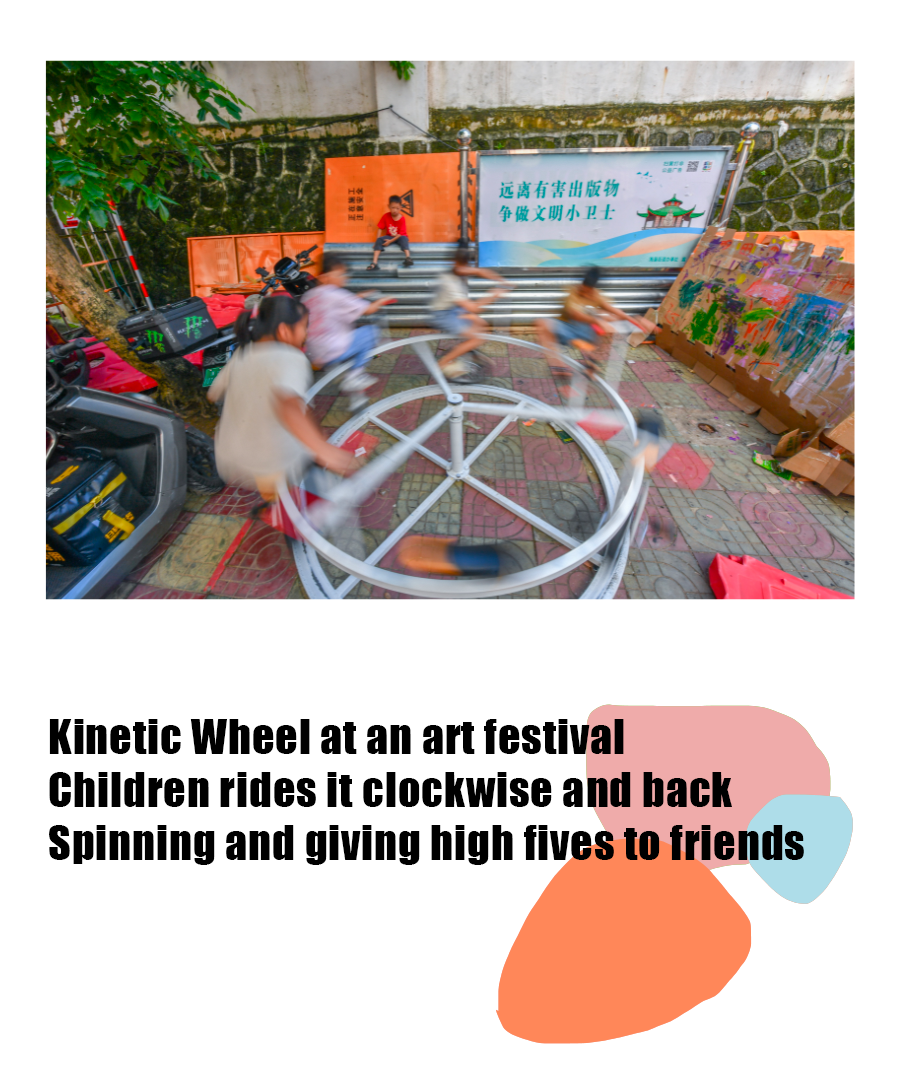


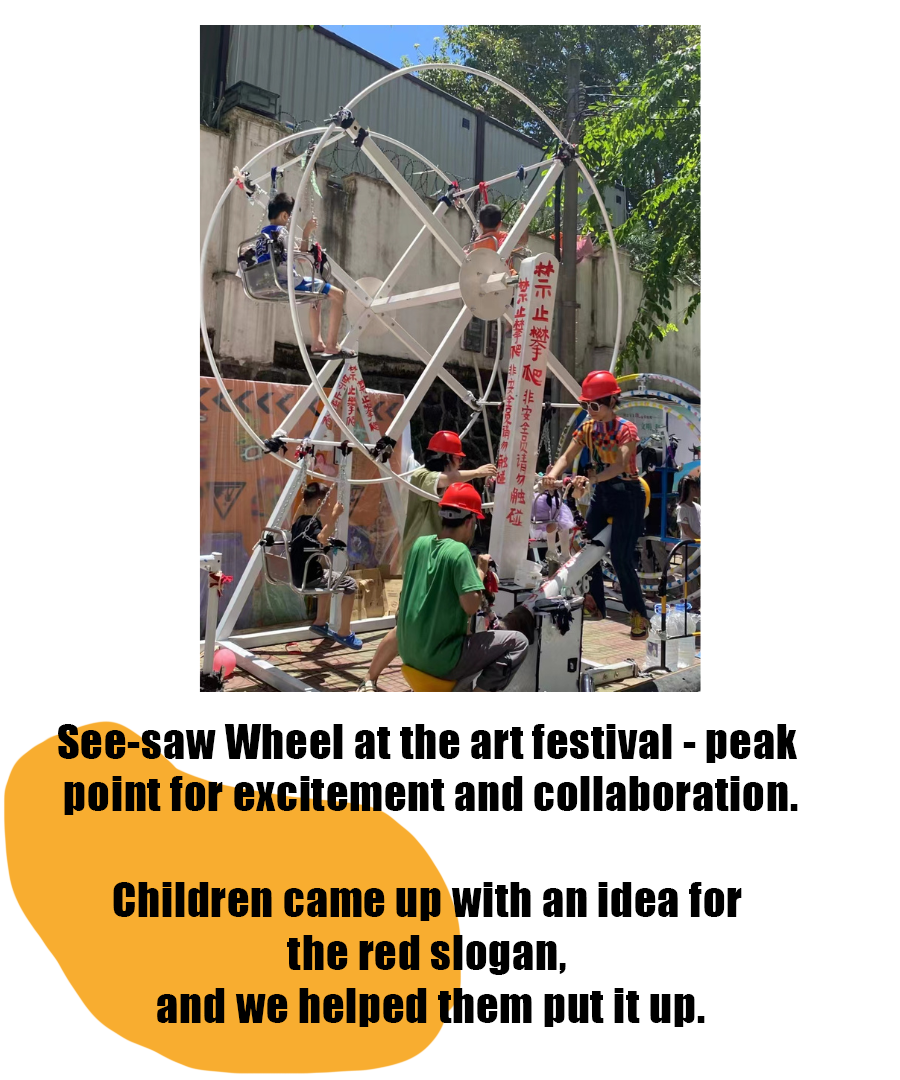


How did we prepare for the typhoon?
How could nothing more than tape, rope, and wire withstand a Category 17 typhoon?

Initial preparations:
Two days before the typhoon, we heard about it from Haoduo, and the team decided to dismantle the Ferris wheel on the tallest piece of equipment—the Kinetic Wheel—and reinforce it.
At that point, we didn’t yet know Typhoon Yagi’s actual wind force, speed, or central pressure. But thanks to Melon’s background in fluid mechanics and years of aerodynamic design experience, we had a clear idea of how to prepare.
The real challenge was figuring out how to reinforce the Playground without Walls on a tight budget, with limited manpower and time, so that it could survive the storm.

At the arts festival, children painted on the Comic Hamster Ball.
On the morning of September 4, Melon quickly estimated the wind speed. Taking into account the eye’s pressure, sea-surface temperature, and air temperature along the storm’s path, he concluded that winds near the center could exceed Category 17—around 62 meters per second, possibly reaching 70.
But the Playground without Walls sits in an urban village: a dead-end alley to the south, Binya Road to the north, the tall walls of Nongken Middle School to the east, and residential blocks to the west. Together, they create a highly complex airflow pattern.
Intuitively, this setting should lower wind speeds near the ground compared to the open center of the typhoon, since the terrain generates turbulence and vortices. However, there’s also a chance that those vortices could overlap and actually accelerate the wind.

In short: Drawing on his experience, Melon quickly ran the numbers and concluded that the playground site was unlikely to face the typhoon’s maximum winds—though unexpected gusts were still possible.

Using Google Maps and his knowledge of the village terrain, Melon sketched out an airflow model in his head and ran the numbers. Even if the vortices amplified each other, he estimated, the wind speeds at the playground could not exceed those at the typhoon’s center.

So the reinforcement plan was based on 62 m/s winds, with a 25% safety margin, meaning that we prepared for 77.5 m/s.
The dynamic pressure of winds at 77.5 m/s can be approximated using Bernoulli’s principle. But the playground’s shapes required adjustments: the wind-facing surfaces are small, and air flowing past them creates turbulence that generates some pressure on the leeward side. That reduces the pressure difference, meaning the real value must be lower than the raw Bernoulli calculation.
Luckily, the equipment itself has simple forms—its wind-facing sections are either circular or rectangular—making the math much easier. After calculations and estimates, Melon concluded that under those conditions, the average pressure difference would not exceed 204 kilograms per square meter.
Note: For easier understanding, we have converted newtons into kilograms.
In short: After careful consideration, Melon adjusted the standard calculations to account for the playground equipment’s unique shapes and arrived at concrete figures.
The pressure difference sounds huge, but in aircraft design these values are quite common—typical for low-speed vehicles. That meant we could rely on simple, everyday materials like rope, tape, and wire for reinforcement.
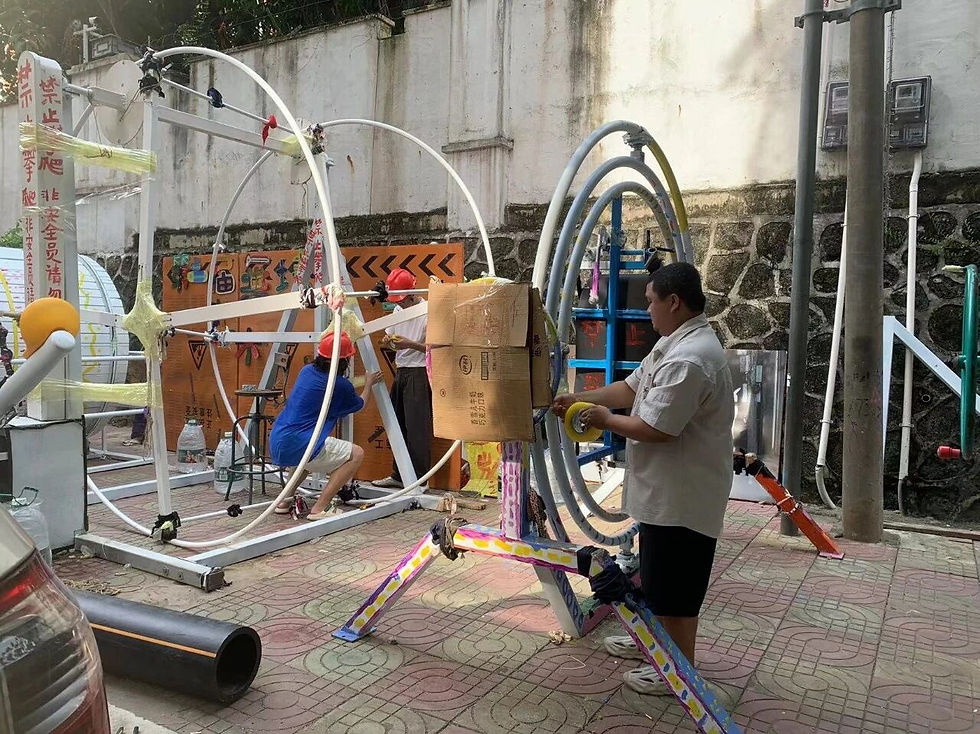
Stabling the Playground without Walls together
For the See-saw Wheel, in theory we only needed to remove the seats rather than the entire wheel. But to guarantee safety—and to ease everyone’s worries—we chose to dismantle the whole wheel and tie it to the main support. The materials were simple: rope wrapped twice around the joints, and tape wrapped forty times.

The fastening structure created with transparent tape.
The rope only served to hold things in place temporarily so that taping was easier; the real load-bearing came from the tape. Its strength was far beyond what most people expected.
According to Melon’s tests, the transparent tape we bought could withstand 8 kilograms of tension per strip. With forty loops, that meant the equivalent of 80 strips pulling at once—up to 640 kilograms of force. A single joint could therefore withstand the wind force on more than 3 square meters of surface area, while the actual exposed area of the entire structure was under 1 square meter.
On the See-saw Wheel, we created six such reinforced joints with tape—leaving us with more than ten times the required strength.

The Kinetic Wheel and the Space Ring had small wind-facing surfaces and relatively heavy weight, so they didn’t need extra reinforcement.
As for the Comic Hamster Wheel, its cylindrical shape and placement close to the ground meant that when facing the wind, it didn’t generate lift. In fact, it generated negative lift—so the stronger the wind, the more firmly it stayed in place, making it even less likely to be blown away.

We wrapped the sharp ends of the wire with tape and added a “For Typhoon Safety” label.
In crosswinds, the Comic Hamster Wheel’s exposed surface area was so small that the lift generated was never greater than its own weight. So even from the side, it couldn’t be lifted away.
However, whether hit head-on or from the side, the wind created torque that made the Hamster Wheel spin. That meant it could rotate noisily in strong winds.
So we decided to wire it tightly to the frame to stop it from turning. Melon calculated that four connection points, each with a single loop of wire, would be enough. To be extra safe, we also added 110 kilograms of ballast inside—12-liter bottles of mineral water.
In short: the stronger the wind, the steadier the Hamster Wheel. It was never at risk of being blown away, but it could spin and make noise—so all we needed to fix was the noise.

By 5:30 p.m. on September 4, we had finished all the reinforcements. At that time, the typhoon’s gale-force winds were still out over the South China Sea, and Haikou was calm. The children likely had no idea what we were doing or why reinforcing the equipment even mattered.
While we were reinforcing the playground, the children were in school, so we didn’t see them or have the chance to talk about the typhoon.
The next day, we found out that all the wires we had used to secure the Comic Hamster Wheel had been cut, and the water bottles we had used as ballast had vanished.
Meanwhile, the children were happily playing inside the Hamster Ball.


A small twist:
because of the approaching typhoon, Becca and Melon moved their flights up from the 6th to the evening of the 4th.
So when the cut wires were discovered, the two main team members were already off the island. DunDun, who stayed behind, led the second round of reinforcement.
At the same time, Haoduo relayed that community staff wanted the playground removed, but with the typhoon approaching, relocation was no longer possible.
After discussions, DunDun, Haoduo, and Teacher Zhou reached an agreement with the community: we would ensure the equipment’s safety through reinforcement and fully explain to the children what we were doing.
Since the ballast was gone, we increased the number of wire loops at each connection—from one to twelve. In terms of strength, that was already ten times more than what was necessary. We also attached related explanatory badges to encourage children in the community to join us in protecting play equipment.

Wires reinforcing the Comic Hamster Wheel

Friends of Playground without Walls that supported the Typhoon prevention:👆
The playground built together with the children was fortunate to have their help during the reinforcement. Thanks to these efforts, every piece of equipment survived the typhoon unscathed, ready to continue bringing joy and inspiration to both kids and adults in the future.


Let’s stay connected!
🔗 LinkedIn: [HappyPower in LinkedIn]
📸 Instagram: [@happypowerworld]
📘 Facebook: [HappyPower in Facebook]
🌐 Website: [HappyPower]
Hey, are you trying to find the HappyPower team?
Founder: Becca Liu (贝卡)
👉WeChat: OcO_OcO_OcO
👉Email: echoffline@gmail.com
👉 Whatsapp: +44(738)8912650


Comments